

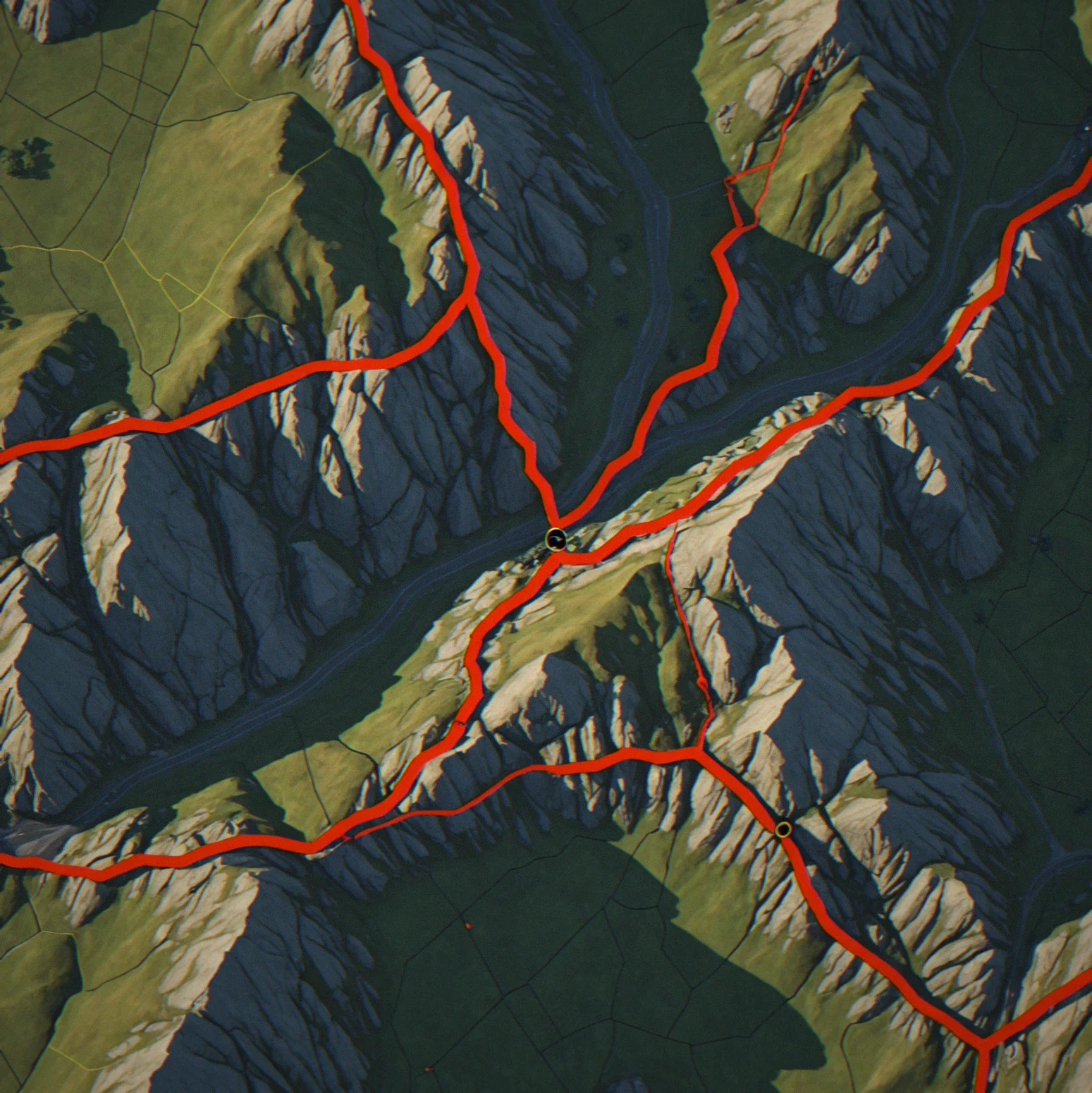
Master elevation. Execute unseen.
Stealth game for people who actually study sightlines and learn how guards move.
16 ridge sectors split across three difficulty tiers. You have to read the terrain—guard cones shift based on where they stand, shadows disappear as time passes, and escape routes close quick. Every target is surrounded by overlapping sightlines. Find the gaps. Time your moves. Stay undetected. Keep your ghost rating. It's pattern recognition at 60 FPS. A few seconds of cloud cover and a patrol cycle are your only chances.
How QuietRidge Works
Three core systems run the whole thing. Get good at each one, then start combining them and things get really interesting.
Height changes what guards can see
Guard vision cones aren't flat. You get 12 meters up above a patrol route and you're in their upper peripheral vision. Drop down to their level and you disappear, assuming the timing works out. The ridge keeps forcing you to think in three dimensions. You're not just memorizing some abstract stealth system. You're doing actual geometry.
Guards repeat the same patterns
They follow routes. Predictable ones. They stop at lookout posts, communiication checkpoints, places to rest. Some break pattern when they're on alert. Most of them stick to the same cycle over and over. You count their steps. You figure out the windows. There's a 12-second gap at the northeast checkpoint every few minutes. That's your opening.
Shadows actually work
You're not just walking through wallls invisible. Torches make hard shadows that shrink as they rotate. Cloud cover drops sight distance by something like 6 to 8 meters. A torch completes its rotation in 40 seconds. Clouds stick around for 30 to 90 seconds. These gaps are real. Tight. Non-negotiable.
Get spotted once and the ghost run is over
You can still get out. You can still finish the objective. But you're detected now instead of a ghost. The speedrunners know the difference. The leaderboard knows. That single second when a guard's head turns toward you—that's where everything happens.
Every way out costs you something
Go down to ground level and you move fast but there's tons of sight around you. Climb up the ridge and you're quuicker but you lose the shadows. Cut through the eastern slope, you shave off a few seconds but you're crossing two patrol routes at once. No perfect choice. Each one makes you pick what matters.
The terrain is the challenge
Flat stealth games boil down to one thing: get from A to B without crossing a sightline. Terrain like this breaks that wide open. Now you've got overlapping zones, elevation differences, and timing that matters. A guard on the ridge face can't see behind the crest. A guard in the valley can't see the approach. You find the gaps between them.
16 Ridge Sectors Across Three Tiers
Early Ridge teaches you the fundamentals. Mid-Slope tightens up the patrol cycles and cuts down those shadow windows. Upper Crest stacks overlapping sightlines with barely any room to extract. You're progressing through actual skill gates here, not just turning up a difficulty dial.
Dynamic Time-of-Day Lighting
Torches come on at dusk. Cloud cover blocks your vision for anywhere between half a minute and an hour and a half. Shadow length shifts every four hours. The same sector feels completely different depending on when you run it—you learn the patterns, then figure out how to use the timing.
Guard Behavior Built on Repetition
Every guard runs a three-minute cycle and most stick to it unless you spook them. They talk to each other. They lock areas down on their own. You figure out their routes by watching them, not by trial and error. The patterns exist. The gaps are real.
Built for Leaderboard Competition
Timer runs. You can restart at checkpoints. No cutscenes slowing you down. Records need full-session video proof. The world record on Ridge 1-A is sitting just under 3:45, and that gap below four minutes? Pure execution. Run competitively or just for yourself—doesn't matter.
Sightline Visualization for Learning
During practice, flip on debug mode and you'll see the guard vision cones in real-time. Get a feel for how it works. Then turn it off when you run for real, because that's when you actually learn. It's a training aid, not a safety net—you stop using it the moment the layout clicks.
No Combat. No Knockouts. Just Movement
Stealth actually means stealth here. You're not fighting guards, hacking equipment, or navigating combat encounters. You move, you find cover, you time your exit. There's some environmental stuff you can do—shift rocks around, blow out a torch if you're feeling brave (risky move)—but the whole thing comes down to reading patterns and executing cleanly.
60 FPS Performance Locked
The Ridge is optimized well. All that verticality doesn't tank your framerate. Timing windows need steady performance and you're getting it on most systems. When your window is just a few seconds wide, smooth performance is non-negotiable.
Tactical Precision
Every decision calculated. Every movement deliberate. Every moment measured in seconds.
Elevation Changes Everything
Drop a few meters and you clear the skyline. Climb that high and you break cover — it matters. The ridge forces you to think in three dimensions, not just horizontal movement. Guard sightlines shift based on your vertical position, so every approach becomes a geometry problem with only a few clean solutions.
Windows Close Fast
A cloud passes overhead for less than a minute. A guard pauses at the checkpoint for a few seconds. Torches rotate roughly every 45 seconds. These aren't generous margins. You learn the timing, you nail the extraction. Miss it by just a couple seconds and the run falls apart — that's the tension that keeps you grinding.
Patterns Repeat. Gaps Exist.
Every guard follows the same cycle unless alerted. They communicate at checkpoints and rest at specific points. So you watch, count steps, find the gap that opens at the northeast tower every few minutes. Once you see the pattern, the level opens up.
Darkness as a Tool, Not a Cheat
Cloud cover reduces sight distance by several meters. Torches cast hard shadows that shrink as they rotate. You're not invisible — you're just harder to see at the right moment. Plan your movement around these windows of reduced visibility. They're real constraints, not hand-holding.
One Alert Ends the Ghost Rating
You can still extract. You can still complete the objective. But the moment a guard spots you, the ghost rating resets. Speedrunners know the difference between a clean ghost run and a detected extraction. That single moment is where the game lives, where execution either holds or cracks.
Get route breakdowns and WR updates in your inbox.
New sectors come out every quarter or so. Speedrun recordds shift constantly. If you subscribe, you'll get emails about patrol pattern changes, what's actually different in the level design and where people are pushing times down. No spam, just technical stuff about what shifted on the ridge and why someone just ran sub-4 on Ridge 1-A.